Property renovations and refurbishments in Teesside
Whole-house refurbishment across Teesside, from a tired three-bed terrace brought back into use to a full strip-back and remodel of a period property. Priced at £600 to £1,300 per square metre depending on how much of the existing fabric survives, quoted as an itemised schedule of works room by room.
Three levels of renovation
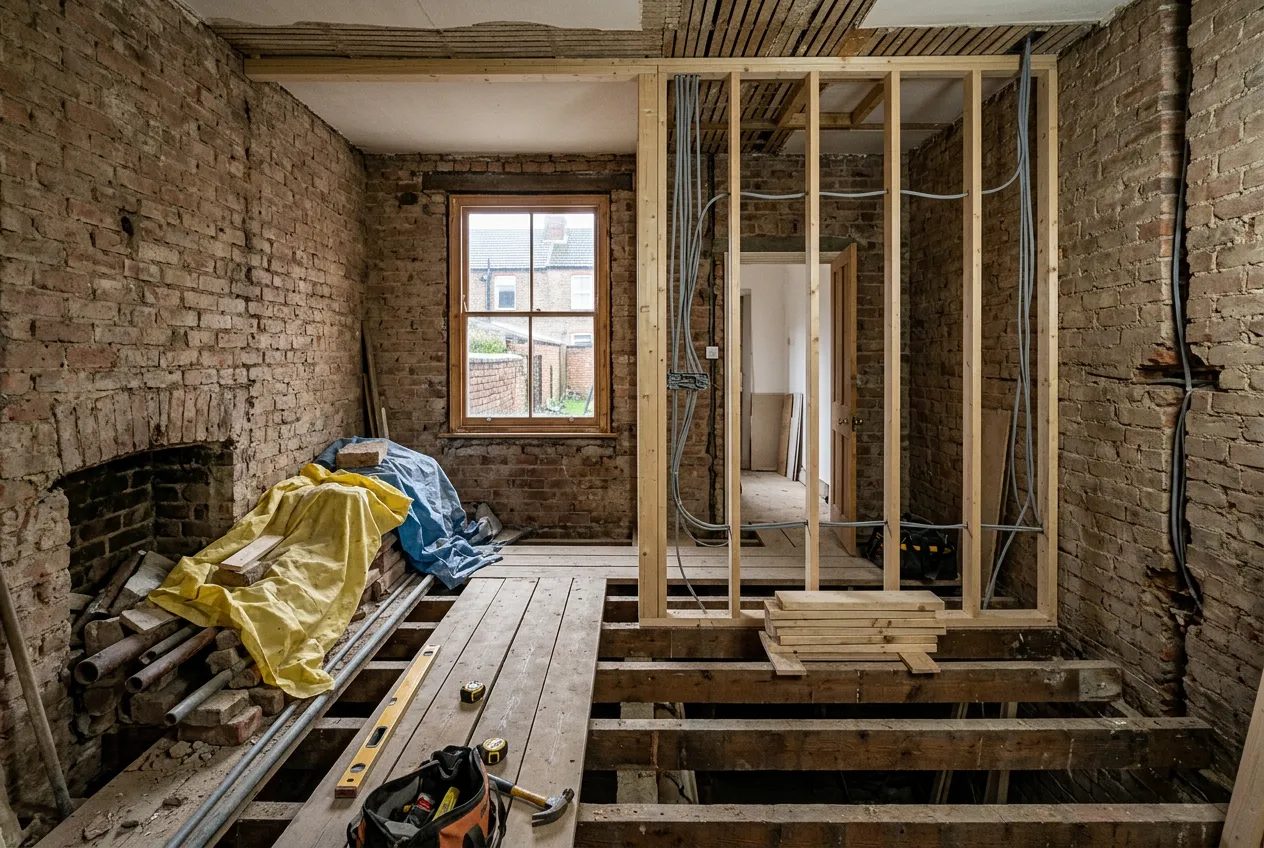
The word covers wildly different jobs, and the first useful step is deciding which one you are buying. A light refurbishment leaves the structure and services alone: new kitchen and bathroom, replastering where needed, joinery, flooring and decoration, typically £600 to £800 per square metre. A full refurbishment strips back to brick and joist, renews the wiring and plumbing, upgrades insulation, replaces windows and re-plasters throughout, at £800 to £1,100. A remodel adds structural change on top: removing walls, moving the staircase, reworking the layout, sometimes an extension alongside, and runs £1,100 to £1,300 and beyond.
The reason the ranges matter is that buy-to-let investors and landlords are usually shopping in the first band while owner-occupiers taking on a period property are almost always in the third, and quotes that do not state which level they cover are impossible to compare.
What Teesside housing stock throws up
The region is dominated by pre-1919 terraces and interwar semis, and both have predictable renovation issues. Terraced properties in Middlesbrough, Stockton, Redcar and Hartlepool commonly present solid nine-inch brick walls with no cavity, failed or absent damp-proof courses, ground-floor joists sitting in damp sleeper walls, lath and plaster ceilings past saving, and rear yards where drainage and levels have been altered several times over a century. Interwar semis in Acklam, Norton, Linthorpe and Hartburn add cast iron drainage, minimal loft insulation and rewires that were last done in the 1970s.
| Element | Guide price | Notes |
|---|---|---|
| Full rewire, three-bed house | £3,800 to £6,500 | Includes new consumer unit and certification |
| Replumb and new boiler | £4,000 to £7,500 | Radiator count and pipe routes drive the price |
| Replaster throughout | £3,000 to £6,000 | Overboarding versus hacking off changes it substantially |
| Damp-proof course and re-render | £1,500 to £4,500 | Only after the real cause is diagnosed |
| New kitchen, supplied and fitted | £6,000 to £18,000 | Units and worktop choice dominate |
| Bathroom, supplied and fitted | £4,500 to £9,000 | Tiling area and moving soil connections matter |
| Roof recovering, typical terrace | £6,000 to £12,000 | Battens, felt, ridge and flashings included |
Damp: diagnosis before treatment
More money is wasted on damp in this region than on any other renovation item, largely because injection chemicals get sold as a universal answer. Rising damp is real but uncommon. Far more local damp is penetrating damp from failed pointing, defective gutters, a bridged cavity or ground levels raised above the damp-proof course by a later patio or path, or it is condensation caused by sealing a Victorian house up without giving it ventilation.
The order of work should be: fix the water getting in, lower the external levels, sort the gutters and pointing, ventilate properly, and only then consider chemical treatment for genuine rising damp. Any quote that leads with injection and re-render without diagnosing the cause deserves a second opinion. This is worth insisting on before signing, because replastered walls hide the evidence for a year or two before the problem reappears.
Sequence and living arrangements
Full refurbishments run in a fixed order for good reasons: strip out, structural work, roof and external envelope, first fix electrics and plumbing, insulation, plasterboard and plaster, drying time, second fix, kitchen and bathroom, flooring, decoration, snagging. Skipping ahead costs money, because a plastered wall chased for a forgotten socket is two trades' work instead of one.
Most Teesside three-bed refurbishments run 8 to 16 weeks on site. Living in the property during a rewire and replumb is technically possible and practically miserable, and it slows the job enough that the extra weeks often cost more than temporary accommodation. Landlords tend to take the void; owner-occupiers usually move in with family or rent short term.
Where renovation meets development
Many refurbishments end up alongside other work, and doing them together saves money on scaffolding, skips, and having the same trades back twice. A rewire is the natural moment to add an upstairs bedroom, a strip-back is the natural moment to open the ground floor up, and a full refurbishment paired with a rear extension almost always costs less combined than sequentially. Investors buying multiple units should look at development-scale pricing too.
Areas We Cover
- Property development in Middlesbrough
- Property development in Stockton
- Property development in Billingham
- Property development in Redcar
- Property development in Saltburn
- Property development in Guisborough
- Property development in Hartlepool
- Property development in Yarm
- Property development in Eaglescliffe
- Property development in Ingleby Barwick
- Property development in Thornaby